

Table of Contents
Share
Instagram
Facebook
Linked In
Share Link
WhatsApp
Social media has transformed from just a place to connect with friends into a vital business asset for building brands, engaging customers, and driving sales. A strong online presence can significantly enhance a small business’s sales and draw in new clients. But achieving this takes more than just posting content; it requires effective social media marketing that focuses on creating real connections. Sharing a variety of content such as customer success stories, helpful tips, or behind-the-scenes looks can strengthen your relationship with followers and help convert them into loyal customers. Companies that regularly post valuable and relevant content while engaging thoughtfully with their audience can establish themselves as leaders in their field.
What is Social Media Marketing?
Social media marketing is all about strategically using platforms like Facebook, Instagram, and LinkedIn to promote your brand, connect with your target audience, and achieve measurable business goals. Unlike traditional advertising, social media allows for real-time engagement: you can share content, respond to comments, and get feedback right away. This two-way communication fosters a sense of community around your brand, transforming passive followers into enthusiastic advocates. By sharing unique content, engaging with your audience, and running targeted ads, social media marketing turns digital platforms into powerful engines for growth.
How to Approach Social Media Marketing?
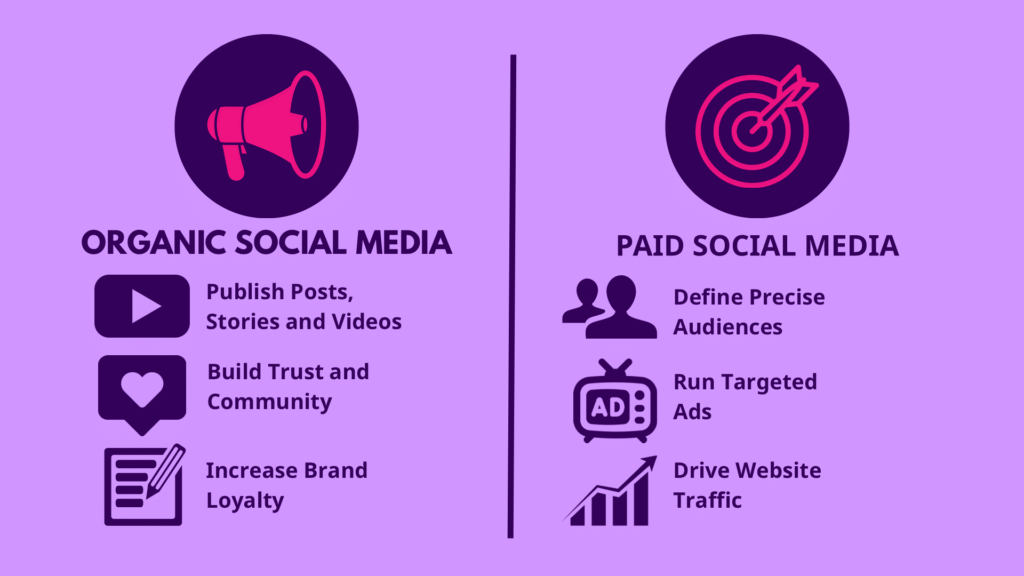
Social media marketing involves both organic and paid strategies. Organic efforts include publishing posts, stories, and videos that inform, entertain, or inspire your audience without direct advertising spend. Paid social, on the other hand, uses targeted ads, leveraging demographic, interest, and behavior data, to reach specific segments quickly and efficiently.
Organic Social Media
Organic social media focuses on growing your audience and fostering engagement naturally, without paid promotion. This approach involves regularly publishing valuable content, such as posts, stories, and videos, that educates, entertains, or inspires your followers.
By interacting authentically in comments and direct messages, you build trust and a sense of community around your brand. Over time, consistent organic efforts lead to stronger relationships, higher brand loyalty, and sustainable word-of-mouth growth.
Paid Social Media
Paid social media leverages advertising budgets to accelerate reach and achieve specific business goals, whether that’s increased website traffic, lead generation, or direct sales. Through platform ad managers (e.g., Facebook Ads Manager, LinkedIn Campaign Manager), you can define precise audiences based on demographics, interests, and behaviors.
Targeted ad formats, such as sponsored posts, carousel ads, and video ads, ensure your message lands in front of the people most likely to convert. It allows businesses to promote special offers, launch new products, and drive website traffic by targeting users based on their demographics, interests, behaviors, and online activity.
What are the Types of Social Media Marketing?
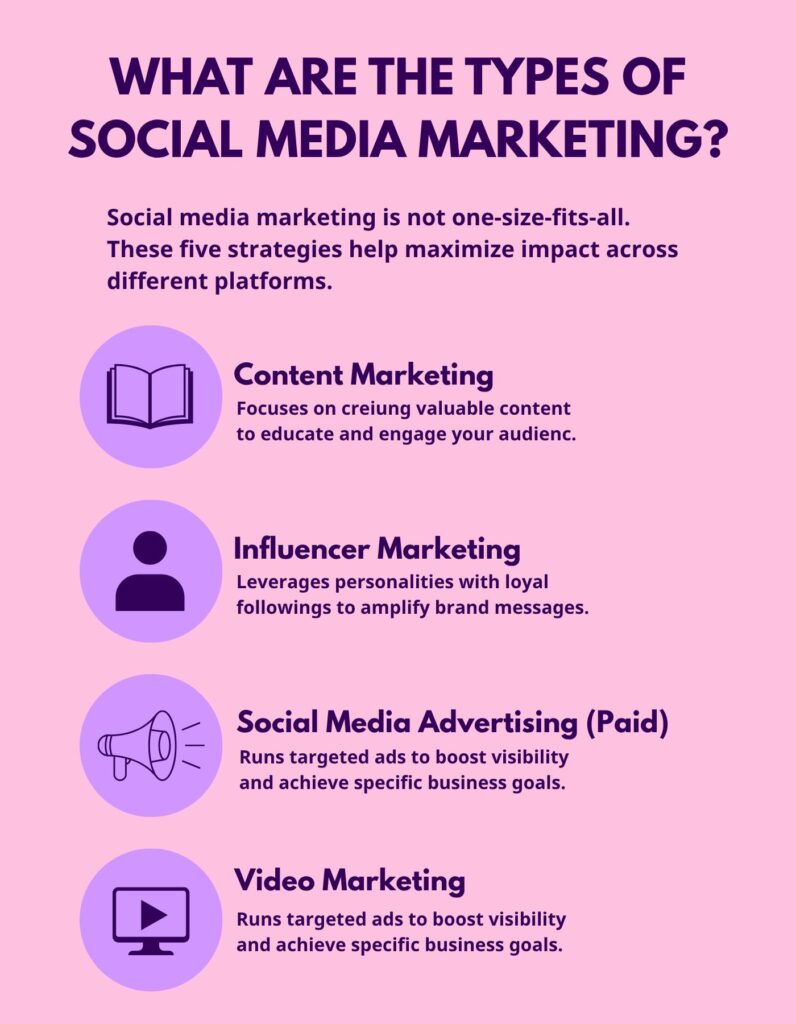
Social media marketing is not a one-size-fits-all approach, it encompasses various strategies that cater to different goals, audiences, and content styles. Understanding the key types of social media marketing helps businesses diversify their efforts and maximize impact across platforms. Here are some of the most effective methods.
Content Marketing
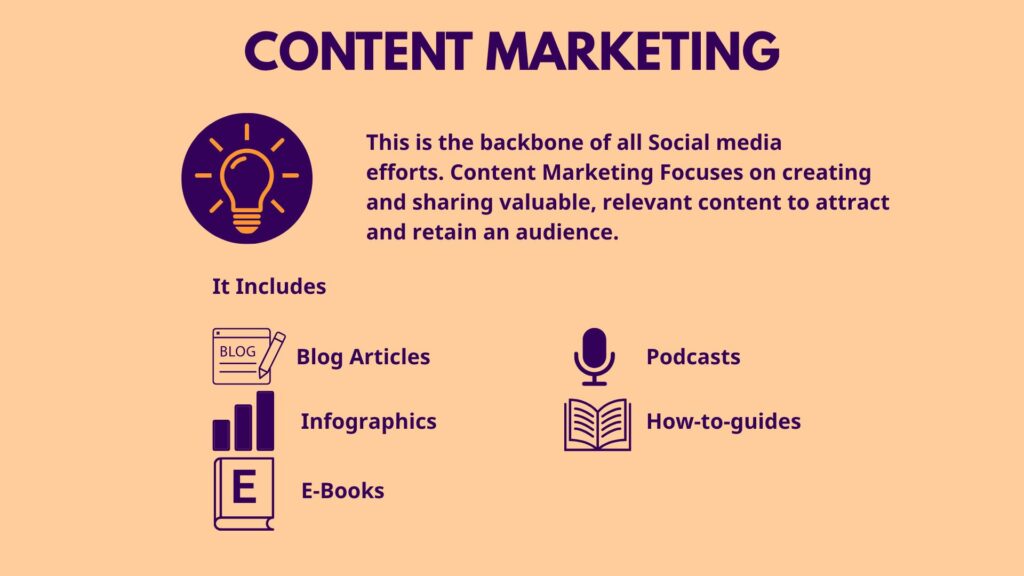
This is the backbone of all social media efforts. Content marketing focuses on creating and sharing valuable, relevant content to attract and retain an audience. It includes
- Blog articles
- Infographics
- Podcasts
- How-to guides
- E-books
By consistently offering helpful and engaging content, brands establish authority in their field, educate their audience, and nurture long-term relationships. Content marketing on social media helps in sparking conversations, answering questions, and positioning your brand as a go-to resource.
Influencer Marketing
Influencer marketing taps into the trust and loyalty that influencers have built with their followers. Businesses collaborate with social media influencers, individuals who have established credibility in a particular niche, to promote their products or services. This type of marketing can range from sponsored posts and product reviews to long-term brand ambassadorships. Influencer marketing works because
- Influencers create authentic, relatable content
- Their endorsements act as social proof
- It helps businesses reach niche and highly engaged audiences quickly
Social Media Advertising (Paid Advertising)
Paid social media marketing involves running advertisements to reach a larger or highly targeted audience quickly. Each platform offers a variety of ad formats and sophisticated targeting capabilities, such as:
- Facebook & Instagram Ads (image, video, carousel, story ads)
- LinkedIn Sponsored Content
- Twitter Promoted Tweets
- YouTube Video Ads
Video Marketing
Video marketing is one of the fastest-growing areas of social media marketing, driven by platforms like YouTube, Instagram Reels, and Facebook Watch. Businesses use videos to:
- Demonstrate product usage
- Tell customer success stories
- Share behind-the-scenes content
- Offer tutorials and how-tos
Video content tends to generate higher engagement and retention compared to static images or text posts, making it a powerful tool for storytelling and brand visibility.
Benefits of Social Media Marketing
Social media marketing offers a wide range of benefits that can accelerate a business’s growth, foster meaningful relationships, and build long-term brand equity. Whether you’re a startup or a well-established enterprise, understanding these advantages can help you leverage social platforms more strategically.
Enhances Brand Visibility and Awareness: One of the most immediate benefits of social media marketing is its ability to expand your brand’s reach. Regularly posting valuable content, engaging visuals, and interactive updates exposes your business to a broader audience.
Builds Authentic Customer Relationships: Social media is not just a broadcast tool; it’s a conversation hub. Engaging with your followers by responding to their queries, acknowledging their feedback, and even sharing user-generated content helps humanise your brand. This two-way communication builds stronger, more personal relationships, turning occasional visitors into loyal brand advocates.
Generates Leads and Boosts Sales: Strategically crafted posts, targeted ads, and special offers can drive website traffic and convert followers into customers. Social platforms like Facebook, Instagram, and LinkedIn allow for precise audience targeting based on demographics, interests, and behaviors. This ensures that your promotional content reaches users who are most likely to be interested in your products or services.
Cost-Effective Marketing Channel: Compared to traditional advertising methods, social media marketing is often far more affordable. Even with a modest budget, you can reach thousands of potential customers through paid ads or boosted posts.
Encourages Community Building: Social media allows you to build a community around your brand where followers can interact not only with you but also with each other. By fostering a sense of belonging, through Facebook groups, branded hashtags, or community challenges, you deepen customer engagement and create a loyal fanbase that actively supports and promotes your brand.
How to Create an Effective Social Media Marketing Strategy?
While social media offers countless opportunities for growth, success doesn’t happen by accident. To make the most of these platforms, businesses need a clear, structured strategy that aligns with their goals and resonates with their audience.
Here’s a comprehensive guide to building a robust social media marketing strategy that drives meaningful results.
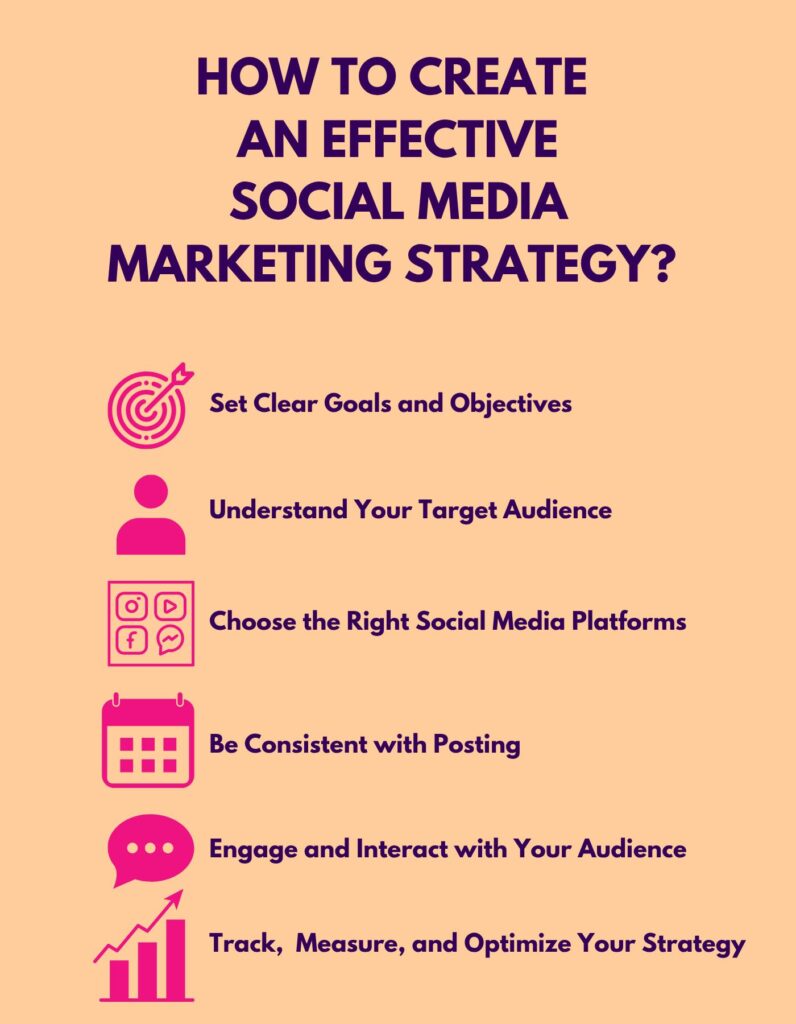
Set Clear Goals and Objectives
Every successful strategy begins with clarity. Before you create content or run ads, you need to define what you’re trying to accomplish. Are you looking to:
- Increase brand awareness?
- Drive traffic to your website?
- Generate leads or boost sales?
- Improve customer engagement or build a community?
By setting SMART goals, Specific, Measurable, Achievable, Relevant, and Time-bound, you can give your strategy direction and a clear way to measure success.
For example, instead of simply saying “I want more followers,” a SMART goal would be: “Gain 1,000 new Instagram followers in the next 3 months by running weekly reels and engaging stories.”
Having well-defined objectives keeps your efforts focused and allows you to allocate resources effectively.
Understand Your Target Audience
Knowing who you’re speaking to is essential for crafting messages that resonate. Start by building a clear profile of your ideal audience
- Demographics: Age, gender, location, occupation, income
- Psychographics: Interests, values, lifestyle, challenges
Behavior: Buying habits, preferred social platforms, content preferences
The better you understand your audience’s needs and pain points, the easier it will be to create content that captures their attention and sparks engagement. You can gather these insights through customer surveys, social media analytics, or industry research. Use tools like Facebook Audience Insights or Instagram Analytics to get data on your current followers.
Choose the Right Social Media Platforms
Not all social platforms are created equal, and you don’t have to be everywhere at once. Focus on platforms where your target audience is most active and where your content style fits best. Selecting the right platforms ensures you maximize reach and engagement without spreading yourself too thin.
Platform | Best For | Content Type | Audience |
Visual storytelling | Reels, Stories | 15–34 | |
B2B, professional thought | Articles, carousels | 20–60 | |
Community & ads | Long posts, videos | 30+ | |
YouTube | Tutorials & long-form videos | Videos | 16–40 |
Create High-Quality, Engaging Content
Content is the heart of your social media strategy. To captivate your audience, your content should be
- Valuable: Informative, educational, or entertaining
- Relevant: Aligned with audience interests and timely
- Visually Appealing: Eye-catching graphics, photos, or videos
Be Consistent with Posting
Consistency builds visibility and trust. Posting regularly keeps your brand top of mind and shows reliability. To stay organized:
- Create a content calendar: Plan posts in advance around campaigns, events, or seasons.
- Use scheduling tools: Platforms like Buffer, Hootsuite, or Later let you schedule posts ahead of time.
- Set a realistic frequency: Whether it’s 3 times a week or daily, consistency matters more than volume.
Engage and Interact with Your Audience
Social media is a two-way street. Don’t just broadcast messages, create conversations. Engaging with followers builds trust and humanizes your brand. When people feel seen and heard, they’re more likely to become loyal fans and advocates.
- Respond to comments and messages promptly.
- Like, share, or comment on user-generated content.
- Ask questions or run polls to encourage participation.
- Thank loyal followers or spotlight customer stories.
Track, Measure, and Optimize Your Strategy
To ensure your social media marketing efforts deliver real results, it’s crucial to consistently monitor performance and fine-tune your approach. Each platform offers unique insights and analytics, here’s how you can effectively track, measure, and optimize your strategy across YouTube, Instagram, Facebook, and LinkedIn.
Key Metrics to Track on All Platforms
- Reach and Impressions: Understand how many people saw your content and how often.
Why it matters: High reach shows strong content distribution; impressions indicate repeated exposure.
2. Engagement Rate: Track likes, comments, shares, saves (and reactions, depending on the platform).
Why it matters: Strong engagement signals that your content resonates with your audience.
3. Click-Through Rate (CTR): Measure how many users clicked on links, CTAs (Call-to-Actions), or website buttons.
Why it matters: A high CTR indicates compelling content and effective CTAs.
4. Follower Growth: Monitor whether your audience is growing, shrinking, or remaining stable over time.
Why it matters: Consistent growth shows rising brand interest and visibility.
5. Conversions: Track how many social interactions result in leads, sign-ups, purchases, or inquiries.
Why it matters: Ultimately, conversions reflect the real business impact of your social media efforts.
Platform-Specific Tracking Tips
YouTube
YouTube Studio Analytics offers key insights like
- Watch Time and Average View Duration: Are people watching your videos fully?
- Engagement Metrics: Likes, comments, shares, and subscribers gained from each video.
- Traffic Sources: Where are viewers coming from (search, suggested videos, external links)?
Click-Through Rate of thumbnails: Are people clicking on your videos after seeing the thumbnail?
Optimization Tip: Experiment with titles, thumbnails, and video lengths based on retention and CTR data. Longer watch times boost discoverability.
Instagram Insights (for Business or Creator accounts) provides:
- Reach & Impressions for posts, Stories, Reels, and Lives.
- Engagement Breakdown: Likes, comments, shares, saves.
- Profile Activity: Website clicks, profile visits, email button taps.
- Audience Analytics: Follower growth, demographics, and activity times.
Optimization Tip: Analyse which content format (Reels, carousels, Stories) performs best and schedule posts when your audience is most active.
Meta Business Suite Insights allows you to monitor:
- Page Reach and Post Reach (organic + paid).
- Engagement Metrics: Reactions, comments, shares, and post clicks.
- Page Likes/Followers: Growth trends.
- Ad Performance: CTR, cost per click (CPC), conversions from paid campaigns.
Optimization Tip: Test different post types (videos, polls, images) and use A/B testing on ads to refine messaging and targeting.
LinkedIn Analytics provides insights such as:
- Impressions and Reach for posts and articles.
- Engagement: Reactions, comments, shares, and link clicks.
- Follower Metrics: Growth, demographics (industry, job titles, locations).
Page Visitors and Button Clicks: Website visits, custom CTA clicks (like “Contact us” or “Visit website”).
Optimization Tip: Focus on content that drives thought leadership (articles, insights, case studies) and track which topics attract industry engagement.
Common Social Media Marketing Mistakes to Avoid
Even with the best intentions, it’s easy to fall into common traps when managing social media. Being aware of these mistakes can save you time, resources, and lost opportunities.
Lack of Clear Strategy
One of the biggest mistakes is jumping into social media without a defined plan. Posting randomly, without clear objectives or understanding your audience, often leads to inconsistent results. A scattered approach makes it difficult to build a recognisable brand or measure success.
What to do instead?
- Develop a content strategy that aligns with your business goals.
- Define your target audience, choose your key themes or topics, and plan your content in advance with a calendar.
CTA Banner can be put here to consult GPS for making social media strategies
Ignoring Engagement
As mentioned earlier, social media is a two-way street. Simply posting content and ignoring comments, messages, or shares can make your brand appear distant or unapproachable. Engagement drives connection and trust.
What to do instead?
- Respond to comments, acknowledge feedback, answer questions, and actively participate in conversations.
- Show your audience that you value their input.
Inconsistency
Inconsistency in posting is one of the most common and detrimental mistakes brands make on social media. Whether it’s posting too infrequently or flooding your feed with content too often, irregular posting can confuse your audience and negatively impact engagement. When brands post inconsistently, followers may forget about your brand, or worse, they may think you’re no longer active or invested in your online presence.
What to do instead?
- To avoid inconsistency, it’s essential to create a realistic posting schedule and stick to it.
- The key is finding a balance that works for both your team and your audience.
Neglecting Analytics
One of the most significant mistakes brands can make on social media is neglecting to track their performance. Without proper analysis of your metrics, it’s nearly impossible to determine which strategies are successful and which are falling short.
Ignoring analytics means you may be unknowingly investing time, effort, and money into tactics that aren’t resonating with your audience. This can lead to wasted resources and missed opportunities for growth.
What to do instead?
- To avoid this, it’s crucial to regularly review your social media analytics.
- Key metrics like reach, engagement, follower growth, and conversions can provide valuable insights into what’s working and what isn’t.
- Tracking these metrics helps you identify trends, gauge audience sentiment, and understand how well your content is performing.
- Use the insights to fine-tune your approach, whether that’s adjusting your content, refining your posting schedule, or experimenting with new strategies.
- By analyzing your performance and making data-driven decisions, you can continuously improve your social media marketing efforts, optimize your strategy, and ensure better results over time.
Failing to Adapt
Social media is dynamic and ever-changing, with trends, algorithms, and user behaviors evolving rapidly. Brands that fail to adapt to these shifts risk falling behind, appearing outdated, and losing their relevance with audiences. What worked yesterday may not work today, and sticking rigidly to old strategies can hinder growth and engagement.
What to do instead?
- To stay competitive, it’s essential to stay updated on industry trends and the latest changes in platform algorithms.
- Regularly review new features, tools, and formats that social media platforms introduce.
- Embrace experimentation with different types of content, such as live videos, Stories, or short-form reels, to keep your strategy fresh and engaging.
Conclusion
Social media marketing is no longer just an option, it’s a necessity for any business aiming to build strong relationships, increase visibility, and drive growth in today’s digital landscape. By understanding its core principles, exploring various platforms and content types, and balancing both organic and paid strategies, businesses can create meaningful connections with their audience. However, success doesn’t come from simply showing up. Consistency, data-driven decision making, and adaptability are crucial to keeping your strategy effective over time.
Resources For You

Add Your Heading Text Here
Add Your Heading Text Here
FAQ's
1. How often should I post on social media?
There’s no one-size-fits-all answer, but consistency matters more than frequency. Aim to post at least 3–5 times per week on platforms like Instagram and Facebook, and 2–3 times per week on LinkedIn. The key is to maintain a schedule you can sustain without sacrificing content quality.
2. Do I need to be on every social media platform?
No, you don’t need to be everywhere. Focus on the platforms where your target audience is most active and where your content style fits best. It’s better to have a strong, consistent presence on 2–3 platforms than to spread yourself too thin across many.
3. Is paid advertising necessary for social media success?
While organic reach is valuable, combining it with paid advertising can amplify your results. Even small ad budgets can help target specific audiences, increase visibility, and drive faster growth. A balanced mix of organic and paid strategies is often most effective.
4. What type of content works best for engagement?
Content that educates, entertains, and inspires typically performs well. This can include client testimonials, how-to guides, behind-the-scenes glimpses, user-generated content, and interactive posts like polls or questions. High-quality visuals and clear, relatable messaging make a big difference.
5. How long does it take to see results from social media marketing?
Social media marketing is a long-term strategy. While you might see small wins (like increased engagement or followers) within a few weeks, significant results, such as stronger brand awareness, customer loyalty, and conversions, often take several months of consistent effort.